Produce · Preserve · Restore · Live Well With the Land
Harmony Homestead
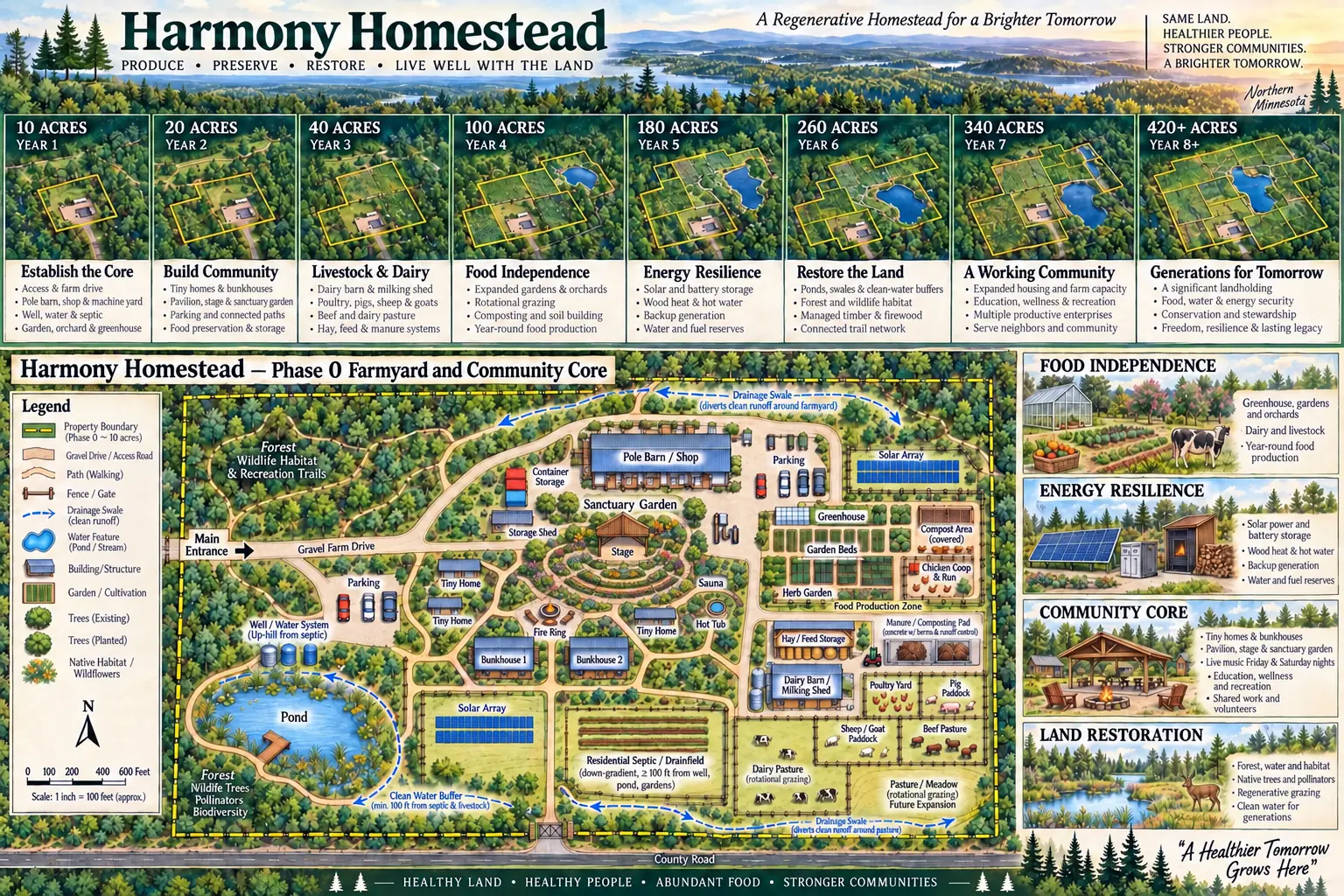
Harmony Homestead is a regenerative agrarian community designed to provide food, shelter, meaningful work, belonging, and long-term resilience through responsible use of the land.
Harmony Homestead
The Answer Is Kindness
The world can be cruel. It can isolate people, consume the land, waste what still has value, and abandon anyone who can no longer keep pace. Harmony Homestead is my answer to that world.
My answer is kindness.
Not kindness as a slogan, and not kindness without judgment. I mean the kind that can be touched: a warm meal, a safe bed, useful work, honest expectations, healthy soil, well-cared-for animals, and people who know they matter because their presence makes a difference.
Kindness must be strong enough to last. It needs responsibility, skill, and systems that do not collapse the moment life becomes difficult. Harmony Homestead exists to make that kind of kindness real.
A Place Built to Sustain Life
Harmony Homestead will be a home, a working farm, and a community organized around a simple purpose: to sustain life well.
The land will provide food, water, heat, energy, shelter, materials, beauty, and meaningful work. We will grow what we can, preserve what we harvest, repair what can be repaired, and keep reserves for the seasons when abundance gives way to need. We will use modern technology where it makes us safer, more capable, and less dependent, while keeping practical alternatives for the systems we cannot afford to lose.
Life here will make room not only for survival and work, but also for beauty, music, rest, and celebration. The sanctuary garden will form a natural auditorium around the pavilion stage, giving the community a place for quiet reflection during the week and live music from bands on Friday and Saturday nights.
This is not a rejection of society. We will remain lawful, connected, and responsible neighbors. But connection should not require helplessness. If the power fails, the heat stops, the market breaks, or the supply trucks do not arrive, life here should continue. The long-term ambition is plain: if civilization disappeared, Harmony Homestead should notice as little as reasonably possible.
The Land Is Not a Possession
We may hold a deed, but ownership does not give us permission to exhaust the land. Soil, water, forest, pasture, wildlife, and livestock are not separate assets. Together they form one living system, and our future depends on its health.
We will build soil rather than mine it. We will protect water, manage drainage and sanitation carefully, prevent overgrazing, regenerate what we harvest, preserve habitat, and turn waste into useful inputs wherever we can. Roads, buildings, fields, animal areas, and water systems will be planned around the natural movement of the land rather than imposed upon it without thought.
The measure of our stewardship will be what remains after us. The soil should be deeper, the water cleaner, the forest stronger, and the land more capable of sustaining life than when we arrived.
Animals in our care will be treated as living creatures, not machines. They will receive clean water, proper food, safe shelter, humane handling, preventive care, and protection from needless suffering. When animals are raised for food, their lives will still be respected, and their processing will be clean, skilled, and humane.
Work, Worth, and Belonging
Every person has value. No one should be reduced to a diagnosis, a difficult season, a past mistake, an empty bank account, or the fact that their body can no longer do what it once did.
Belonging, however, is not the same as entitlement. A community survives only when responsibility moves in both directions. Those who can contribute will contribute, and those who need support will receive it within the community’s capacity. The standard will not be equal output. It will be honest effort suited to a person’s abilities, circumstances, and season of life.
Contribution may be physical labor, but it may also be cooking, cleaning, planning, repairing, teaching, caregiving, recordkeeping, transportation, security, preservation, or simply carrying knowledge forward. Children will learn through age-appropriate responsibility. As people grow older or their abilities change, their work may change with them—from the field to the workshop, from lifting to teaching, from full days to smaller duties. There is no retirement from dignity, belonging, or having something worthwhile to give.
Necessary work deserves respect. No honest task that sustains the community is beneath us, and no title makes a person more valuable than the people whose labor keeps the place alive.
The Promise
To those we welcome into this community, we offer what we can honestly sustain: food, appropriate clothing, safe shelter, essential care, meaningful work, clear expectations, opportunities to learn, and a place among people who recognize their contribution.
We will not promise luxury, wealth, idleness, or freedom from responsibility. We will promise fairness. Expectations will be explained in advance. Agreements involving housing, work, compensation, membership, or business will be written clearly. Limitations and mistakes may be spoken of honestly without humiliation. Good-faith problems will be met with direct communication and a reasonable chance to correct them.
Kindness itself has no boundary. Everyone here will be treated kindly—even when corrected, held accountable, denied a request, or required to leave. Unkindness toward others will not be tolerated. Volunteers, members, workers, guests, and leaders must treat one another with dignity. Kindness does not mean permitting harmful conduct; participation has clear boundaries. A person who repeatedly refuses to treat others kindly cannot remain here, but even separation will be handled without cruelty, humiliation, or retaliation.
Kindness will never require the community to tolerate abuse. Violence, coercion, exploitation, theft, sabotage, harassment, deliberate contamination, dangerous disregard for safety, or persistent refusal to contribute are incompatible with life here. Serious danger may require immediate removal; lesser failures should be addressed fairly and consistently.
Freedom Is Not Negotiable
Harmony Homestead will have structure because land, animals, equipment, money, and human safety require accountable decisions. Structure, however, must never become domination.
No one will be required to adopt a religion, political ideology, or private belief. No one will be isolated from family or society, deprived of lawful property or identification, denied access to communication, or made to seek permission to leave. Membership will be based on contribution, conduct, and compatibility—not devotion to a founder or loyalty to a personality.
Leadership exists to protect the mission and serve the work. It must explain important decisions when practical, keep accurate records, protect private information, apply expectations consistently, accept informed disagreement, correct mistakes, and reject favoritism and retaliation. Authority must remain tied to responsibility, never personal superiority.
Harmony Homestead will not become a cult, militia, prison, forced-labor operation, limitless charity, or refuge from accountability. It will not exploit vulnerable people, sacrifice the land for profit, or use kindness as permission for anyone to cause harm.
Harmony Homestead and Rubi Farms
Harmony Homestead sustains life. Rubi Farms turns responsible surplus into lasting security.
That order matters. The homestead’s food, seed, breeding stock, reserves, and productive capacity come first. What remains may be preserved, traded, shared, donated, or sold through Rubi Farms. We will never weaken tomorrow’s survival to create today’s revenue.
Rubi Farms will sell what the homestead can responsibly spare, and nothing less than excellent quality will carry its name. Everything offered for sale will be safe, lawful, honestly represented, and produced with respect for the land, animals, workers, and customers.
Every part of the homestead must justify the resources it consumes. It should produce income, reduce expenses, strengthen resilience, or be consciously chosen as a luxury worth its cost. Money is not the purpose of this place; it is one of the tools that protects it.
Revenue will first maintain the land, animals, infrastructure, tools, and reserves that made it possible. It will meet lawful obligations, support the people doing the work, reduce debt and outside dependency, and expand productive capacity. True surplus will be converted into durable security: land, equipment, livestock, seed, timber, metals, knowledge, and other assets that retain practical value.
Rubi Farms $ell$ everything—but never at the expense of the homestead’s survival, the land’s health, or the quality of what carries its name.
Technology in Service of Independence
We will not romanticize hardship. Technology is welcome when it reduces dangerous or repetitive labor, helps people contribute, preserves knowledge, improves communication, or strengthens food, water, energy, and production security.
We will favor durable systems we can understand, maintain, and repair. Essential functions will have practical backups, because no single failure should be allowed to disable the homestead. Old knowledge and new tools belong together: hand skills beside automation, wood heat beside modern energy systems, preserved seed beside careful records, and human judgment above convenience.
Our Place in the Wider World
Independence does not mean hostility. Harmony Homestead will respect property boundaries, obtain required permits and licenses, protect neighboring land and water, maintain responsible sanitation and animal control, and cooperate appropriately with public agencies and emergency services.
We will build constructive relationships with farmers, tradespeople, businesses, neighbors, and anyone else willing to deal honestly. We will buy and sell in the market without becoming ruled by it. We will use public infrastructure without allowing our survival to depend entirely upon it. Cooperation will be chosen from a position of capability, not desperation.
The Measure of Success
Success will not be measured by acreage, revenue, buildings, or equipment alone.
We will know Harmony Homestead is succeeding when people have food, shelter, water, warmth, useful work, and dignity; when essential systems continue through outside disruption; when animals are well cared for; when the soil, water, forest, and wildlife improve; when conflict is handled without humiliation or retaliation; when knowledge passes from one generation to the next; and when debt and dependency decline as capability grows.
Rubi Farms must earn sustainable revenue from excellent surplus, but the deeper test is what that revenue protects. People should leave this place safer, more capable, and more independent than when they arrived. The land should bear evidence of our care. Kindness should be visible in daily life, not merely written into our principles.
My Commitment
I am building Harmony Homestead because I believe life can be organized around something better than fear, scarcity, waste, and cruelty.
I will protect the people, and the land. I will care for the animals, maintain the systems, preserve what we produce, and treat people with dignity. I will expect honest contribution from everyone, including myself. I will not promise a life without work. I will help build a life in which work matters, needs are taken seriously, and contribution creates genuine belonging.
This is not an escape from the world. It is an answer to it.
The answer is kindness.
Kindness without boundaries.
Kindness with responsibility.
Kindness made durable through land, labor, skill, and community.
Benefits
Benefits of the Harmony Homestead Model
The biggest benefit is that Harmony Homestead can support your life before Rubi Farms makes a single sale.
Food you eat, firewood you use, and materials you put to work have value to you without first being sold. Rubi Farms then creates a commercial outlet for what the homestead produces beyond its needs.
That distinction changes the purpose of the whole operation:
Harmony Homestead exists to provide the life you want. Rubi Farms exists to monetize the surplus—not make your life subordinate to production targets.
The benefits below follow from that design. Your overview establishes the intended system; it does not yet establish its actual costs, profitability, or level of independence.
1. Less money has to leave the household
Your model has two ways to improve your position: replace something you would otherwise purchase, or produce something worth selling.
For example, the garden’s first contribution can be food for your household. The woodland’s first contribution can be heating fuel or usable materials. Neither has to generate a customer transaction to serve its purpose.
This is consistent with agricultural enterprise budgeting, which recognizes production used within the operation—not just products sold outside it. The important comparison is the value received against the full cost of producing it.
For you, the potential benefit is a smaller gap between what your household needs and what you must earn elsewhere to obtain it.
That does not mean homegrown food or your own firewood is free. It means the project can be evaluated on more than sales revenue.
2. The same production system can support your household and generate revenue
Your diagram shows a useful relationship between household provision and commercial surplus:
System in your overview
Harmony Homestead receives first
Rubi Farms can monetize afterward
Gardens and orchard
Food for immediate use and preservation
Surplus produce and suitable preserved products
Livestock
Household meat and eggs
Surplus products that meet your quality standard
Bees and maple production
Honey and syrup for household use
Surplus honey and syrup
Forestry and materials
Firewood, timber, and materials needed on the property
Surplus firewood, timber, and finished wood products
The benefit is that you are not necessarily building one system for personal use and another entirely separate system for sales. The commercial activity can grow from production capability you already want for the homestead.
But surplus is not automatically profitable. Handling, packaging, storage, transportation, selling time, and customer service still matter. University of Minnesota Extension specifically recommends evaluating costs, returns, and profits by sales outlet—not merely how much a market allows you to sell.
Your homestead-first distinction therefore protects an important boundary: sales should improve the homestead’s position, not consume the supplies, time, or capacity needed to keep it functioning.
3. Outside disruptions can have a smaller effect on daily life
Your energy, water, food-storage, and heating systems are intended to provide alternatives when an outside service becomes unavailable.
The potential benefit is not simply owning backup equipment. It is maintaining useful functions: keeping food cold, keeping the residence warm, obtaining water, and powering essential equipment.
For electricity, this is technically achievable within defined limits. The Department of Energy describes solar-plus-storage systems designed to disconnect from the grid and operate in an “islanded” mode during an outage. That requires the appropriate system design; an ordinary solar installation is not, by itself, proof of backup capability.
Applied to your concept, the useful question becomes:
“What can continue operating when the outside service stops, and for how long?”
That is a more meaningful benefit than an off-grid label. You can remain connected to useful services while building the ability to continue without them for a planned period.
4. The property’s systems can support one another
Your overview is stronger as a connected system than as a collection of unrelated projects.
The woodland is not shown only as timber for sale. It also supplies firewood, materials, and habitat. Water infrastructure supports household needs, irrigation, and livestock. The workshop supports the equipment used across the property.
There is an established agricultural basis for deliberately combining compatible uses. USDA identifies benefits from integrating trees with agricultural systems, including useful products, income opportunities, protection for soil and livestock, improved water quality, and pollinator and wildlife habitat. Those benefits depend on appropriate design and management—not simply putting several activities on the same acreage.
For Harmony, the potential advantage is getting several useful returns from the same land and infrastructure without exhausting the resource that produces them.
That supports your goal of living in harmony with the land rather than treating every acre as something that must be pushed into maximum short-term production.
5. Rubi Farms can have a clear reason for customers to buy
Your requirement that nothing less than excellent quality leaves Rubi Farms gives the business a defined standard.
The customer-facing proposition is not, “Please buy whatever I happened to have left over.”
It is:
“These are excellent products from a homestead that produces for its own needs first.”
That is a meaningful distinction between surplus quantity and inferior quality. Something can be surplus because you have more than you need—not because it is undesirable.
University of Minnesota Extension notes that direct-market buyers have specific expectations about product quality, packaging, and service; many retail and food-service buyers also require consistency. Your quality rule addresses an important part of that relationship, although it does not by itself guarantee demand or premium prices.
The benefit is a business identity you can apply across different products while maintaining one standard. “Rubi Farms sells everything” does not override “nothing less than excellent quality leaves.” Both criteria remain in force.
6. Your work can build lasting capability
In your model, part of the return from an improvement is what it allows you to do afterward.
An orchard represents future food-production capability. A functioning workshop represents maintenance and repair capability. Water storage represents an operating reserve. Food preservation represents the ability to carry production beyond the harvest.
The distinction is between having a product once and having a functioning system that can keep providing it.
Your diagram’s reinvestment loop is important here:
Production → household support → surplus → sales → reinvestment → a stronger homestead.
The intended benefit is that commercial proceeds can strengthen the system that supports you, rather than requiring continual expansion simply to keep sales growing.
That is productive capacity—not a guarantee that every improvement will increase the property’s resale value.
7. The plan gives you a way to control scope
Your existing test—make money, save money, or provide a luxury you consider worth its cost—gives each proposed addition a reason to exist.
The systems overview adds another useful question:
“What does this component do for the rest of the homestead?”
A well does not need to sell water to be valuable. A workshop does not need to become a public repair business to support the project. Their contribution can be the essential functions they provide to the household and production systems.
Conversely, a product can generate sales and still be a poor use of resources. Enterprise budgets are specifically intended to distinguish profitable activities from break-even or losing ones by including variable and fixed costs.
The benefit is clearer decision-making: you can distinguish something that strengthens the homestead from something that merely adds activity.
More enterprises, more equipment, and more sales are not automatically a better result for you as the customer.
The main tradeoff: independence must remain manageable
The strongest version of this concept reduces outside dependence without making you responsible for an unmanageable number of daily obligations.
Your time and operating capacity belong in the evaluation alongside land, buildings, and money. A system that only works when you are available every day, nothing breaks, and every harvest succeeds has not delivered the resilience shown in the diagram.
Financially, the benefits also need to survive a full accounting of costs. University of Minnesota Extension recommends comparing actual results with budgets and examining both expenses and revenue when assessing whether farm operations are meeting their goals.
So the benefit is not “everything becomes free” or “every surplus product becomes profit.” It is the possibility of building a household that requires less outside support, retains useful reserves, and earns worthwhile revenue from genuine surplus.
Bottom line
Harmony Homestead’s primary return is a well-provided-for life. Rubi Farms’ return is the additional value recovered from what that life-support system produces in excess.
Done well, the model gives you more control over what you consume, what you depend on, what you sell, and how much commercial activity you allow into your life.
The farm supports the homestead. The homestead serves you.
Systems
Rubi Homestead — Systems Outline
Purpose
Rubi Homestead is an integrated life-support system built around the land. Its purpose is to provide food, water, shelter, energy, useful materials, and income while maintaining the land’s ability to keep providing them.
The homestead can remain connected to utilities, markets, and modern services. The goal is to make those connections useful rather than essential to keeping the household functioning.
Every component must produce income, reduce costs, or be a consciously chosen luxury whose value justifies its cost.
1. Land, Soil, and Ecosystem System
The foundation supporting every other system.
- Land-use organization: Identify areas for living, working, gardens, orchards, livestock, woodland, water, access, and conservation.
- Soil and fertility: Manage soil condition, compost, organic matter, manure, ground cover, and erosion.
- Ecosystem stewardship: Maintain wildlife habitat, pollinator resources, healthy woodland, and protected water resources.
The objective is not to develop every acre. It is to make the different parts of the property work together without exhausting them.
2. Water System
Provide water for people, animals, food production, and property operations.
- Supply and distribution: Household water source, pumping, treatment, storage, plumbing, livestock watering, and irrigation.
- Water retention and management: Rainwater collection where appropriate, drainage, runoff control, soil-water retention, and potential stock ponds.
- Continuity: Plan how essential water needs would be met during power failures, equipment breakdowns, drought, and winter conditions.
Your proposed stock pond and irrigation-stream concept belongs here, with any hydroelectric component evaluated jointly under the energy system.
3. Electricity, Heat, and Energy Storage System
Remain grid-connected while developing the ability to maintain essential services without the grid or utility gas.
- Electricity: Solar generation, electrical distribution, essential-load circuits, battery storage, controls, and backup-generation planning. Wind remains a site-dependent possibility.
- Heat and hot water: Wood-fueled heating, domestic hot water, building efficiency, fuel preparation, and seasonal fuel storage.
- Future energy projects: Microhydro, the pond-and-creek concept, pumped-water storage, flywheels, thermal storage, and wood-fueled electricity generation.
Those future projects remain feasibility studies—not assumed sources of dependable power. The system must distinguish what is installed and proven from what is still conceptual.
4. Gardens, Orchard, and Plant-Food System
Produce food for the household first, with preservation and surplus sales built into the plan.
- Annual food production: Vegetables, staple crops, herbs, planting schedules, seed inventory, and garden infrastructure.
- Perennial food production: Apple orchard, other suitable fruit, berries, and long-term perennial plantings.
- Production planning: Match planting quantities to household consumption, preservation capacity, available labor, and a realistic market for surplus.
Food production connects directly to water, soil management, pollination, storage, and seasonal labor.
5. Livestock and Beekeeping System
Include your planned beef cattle, sheep, pigs, chickens, and bees as working parts of the homestead.
- Livestock production: Define each species’ role in household food, land management, useful by-products, and surplus sales.
- Feed and animal care: Pasture, forage, winter feed, water, fencing, shelter, handling, bedding, and veterinary needs.
- Beekeeping: Honey production, pollination, hive management, equipment, and honey processing and storage.
Animal numbers must be planned alongside the land’s capacity, winter-feed supply, processing arrangements, and the amount of daily work you can sustain.
6. Food Processing, Preservation, and Storage System
Turn seasonal production into a dependable year-round food supply.
- Processing: Space, equipment, and arrangements for handling produce, meat, eggs, honey, and maple syrup.
- Preservation: Canning, freezing, drying, fermentation, and other appropriate methods.
- Storage and inventory: Pantry, freezer, and suitable cool-storage capacity; labeling, stock rotation, meal planning, and surplus tracking.
Production is not complete when food is harvested. It is complete when the food is safely stored, eaten, or sold.
7. Woodland, Timber, and Wood-Products System
Use the woodland for heat, materials, income, and long-term resource security.
- Forest management: Woodland inventory, selective harvesting, regeneration, access, and habitat protection.
- Wood products: Household firewood, surplus firewood sales, usable timber, lumber, and potential value-added woodworking.
- Maple production: Suitable trees, seasonal collection, syrup processing, storage, and sales.
Woodland operations should connect heating needs, equipment capacity, available labor, and forest health rather than treating timber as a one-time liquidation.
8. Shelter, Buildings, and Workspaces System
Provide a practical year-round living and working base without assuming a separate conventional house.
- Residential space: The shop-house concept and temporary accommodation during development.
- Working buildings: Shop, equipment storage, food-handling areas, animal shelter, and protected storage for tools and materials.
- Community gathering: A pavilion with an integrated performance stage will anchor a sanctuary garden designed as a natural auditorium. Bands will play Friday and Saturday nights, while the garden remains available for quiet reflection, gatherings, and community events at other times.
- Building performance: Insulation, ventilation, moisture control, heating, plumbing protection, and maintainable layouts.
Keep household living, dirty shop work, animal operations, and clean food-handling functions appropriately separated.
9. Equipment, Maintenance, and Fabrication System
Maintain the homestead’s ability to build, repair, harvest, and move materials.
- Land-working equipment: Tractor or skid steer, attachments, mowing and brush equipment, snow-removal equipment, chainsaws, and wood-processing tools.
- Workshop capability: Vehicle and equipment maintenance, fabrication, woodworking, and ordinary building repairs.
- Maintenance support: Service schedules, manuals, spare parts, consumables, fuel storage, and an organized tool inventory.
Evaluate equipment by the work it performs, costs it avoids, and income it can support—not simply by whether it would be useful to own.
10. Waste, Sanitation, and Nutrient-Recovery System
Handle waste safely and recover useful materials where practical.
- Sanitation: Household wastewater, toilets, wash water, and the associated maintenance requirements.
- Organic materials: Compostable garden material, manure, bedding, and suitable food residuals.
- Other waste: Packaging, scrap metal, used oil, chemicals, broken equipment, and materials that require outside disposal.
The planning goal is to identify which outputs can become useful inputs elsewhere—and which must remain separate.
11. Access, Transportation, and Expedition Interface
Keep people, supplies, equipment, and products moving through the property and beyond it.
- Property access: Entrance, driveway, service routes, trails, turnarounds, loading areas, and winter access.
- Working transportation: Livestock, feed, timber, equipment, supplies, and product hauling.
- Rubi Expedition connection: Mother Ship parking and servicing, Rubi storage and maintenance, trailer space, and shared workshop or utility resources.
The expedition system and homestead should support each other without making either project dependent on completing the other.
12. Communications, Monitoring, and Controls System
Provide information and useful automation without making daily operations unnecessarily complicated.
- Communications: Internet, phones, local radio, and communication between people working in different areas.
- Monitoring: Water levels, temperatures, energy status, freezer conditions, equipment faults, and other important operating conditions.
- Controls and records: Simple alerts, maintenance reminders, inventories, maps, manuals, and accessible operating instructions.
For essential functions, identify what still works when internet service, an app, or an automated controller is unavailable.
13. Safety, Security, and Emergency Continuity System
Protect the household, animals, property, and essential supplies.
- Safety: Fire prevention, first aid, safe equipment operation, emergency access, and appropriate storage of hazardous materials.
- Security: Gates, locks, lighting, observation, and the previously explored camera or drone concepts.
- Continuity: Plans for severe weather, prolonged outages, equipment failure, animal-care interruptions, and times when you are sick or away.
Medical care, replacement parts, purchased supplies, and other remaining outside dependencies should be recorded rather than treated as solved.
14. Income, Expenses, and Real-Asset System
Make the property economically sustainable while keeping household support at the center.
- Production and savings: Track food used by the household, purchased energy replaced, repairs completed, and other avoided expenses alongside actual cash income.
- Surplus sales: Food, honey, maple syrup, firewood, timber, wood products, and other outputs the property can support.
- Money and assets: Operating expenses, maintenance reserves, reinvestment, sales records, and your proposed conversion of surplus proceeds into silver and other tangible assets.
Previously explored businesses—such as lodging, retreats, storage, land services, and the licensed cannabis microbusiness concept—belong in separate enterprise plans, with their own costs, labor requirements, and operating assumptions.
15. Labor, Scheduling, and Homestead Management System
Make the whole property manageable as one operation.
- Daily and seasonal work: Animal care, planting, harvesting, food preservation, maple season, firewood, maintenance, and winter preparation.
- Inventory and purchasing: Food, seed, feed, fuel, parts, tools, and supplies, including replacement timing.
- Operating documentation: A property map, system inventory, maintenance calendar, task priorities, and instructions another person could follow.
The workload is part of the design. A system that depends on you being available, healthy, and productive every day needs that dependency addressed.
How the Systems Connect
Resource or activity
Connected uses
Gardens and orchard
Household food, preserved food, surplus sales, and suitable compost inputs
Livestock
Household food, potential sales, land management, and managed manure or bedding recovery
Bees
Honey production and pollination within the food-production system
Woodland
Heating fuel, maple products, timber, materials, habitat, and income
Water infrastructure
Household supply, livestock, irrigation, and potential future energy projects
Energy infrastructure
Water pumping, food storage, lighting, communications, workshop functions, heat, and hot water
Workshop and equipment
Construction, land management, repairs, harvesting, transportation, and potential service income
Surplus income
Operating expenses, upkeep, productive improvements, reserves, and planned tangible assets
Standard Record for Every System
Each system’s planning section should identify its purpose, required inputs, useful outputs, outside dependencies, labor requirements, maintenance needs, failure response, costs, income or savings, and development status.
Use three development statuses: operating, planned, or future study. This keeps the long-term vision intact without confusing an idea with a functioning capability.
Volunteers
What Volunteers Receive in Return
Harmony Homestead will never treat volunteer labor as free labor. Every person who contributes should receive something real, dependable, and proportionate in return.
The basic exchange is straightforward:
You contribute honest work to the homestead. In return, the homestead helps provide the necessities, security, skills, relationships, and opportunities that make a good life possible.
The Foundation: Essential Needs
Within the homestead’s resources and the terms of each person’s agreement, participating volunteers may receive:
- Safe, clean, weather-appropriate shelter.
- Nutritious meals made from the best food the homestead can provide.
- Clean drinking water.
- Heat, electricity, sanitation, laundry, and bathing facilities.
- Appropriate clothing for the season and the work.
- Necessary tools, protective equipment, and work supplies.
- Transportation connected to assigned homestead responsibilities when available.
- Reasonable assistance during illness, injury, emergency, or temporary hardship.
These are not prizes awarded only to the strongest workers. They are the foundation that allows people to live with dignity and contribute safely.
A Place at the Table
A volunteer should receive more than a bunk and a work assignment. They should have a genuine place within the life of the homestead.
That includes:
- A seat at shared meals.
- Inclusion in celebrations, traditions, and community events.
- Respectful treatment regardless of the job performed.
- Recognition for useful work and dependable service.
- Reasonable privacy and personal space.
- Time for rest, recreation, outside relationships, and personal interests.
- The freedom to express concerns without humiliation or retaliation.
- Clear expectations instead of constantly changing demands.
- A fair process for resolving disagreements.
- The right to leave freely.
Belonging should be real, but it should never be used as leverage to control someone.
Practical Education
Every volunteer should have opportunities to leave Harmony Homestead more capable than when they arrived.
Depending on the work available, volunteers may learn:
- Gardening, greenhouse production, and seed saving.
- Food preservation, cooking, baking, and safe food handling.
- Animal care and pasture management.
- Forestry, maple production, beekeeping, and orchard care.
- Carpentry, welding, equipment operation, and mechanical repair.
- Plumbing, electrical, energy, and water-system fundamentals.
- Firewood processing and responsible timber management.
- Construction, maintenance, sanitation, and workplace safety.
- Business operations, inventory, sales, budgeting, and recordkeeping.
- Emergency preparedness and first-response skills.
- Leadership, project planning, teaching, and conflict resolution.
Training should not be limited to the task needed that day. Whenever practical, experienced people should explain why the work matters, demonstrate it properly, supervise it safely, and help others develop independent competence.
Material and Economic Benefits
Volunteers may not receive conventional wages unless they are separately hired as employees, but their contribution should still produce meaningful economic value in their lives.
Depending on the written arrangement, that value may include:
- Eliminated housing costs.
- 3 Regular meals per day and household necessities.
- Access to clothing, tools, equipment, and transportation.
- A share of eligible food produced for household use.
- Training that improves future employment or self-sufficiency.
- References documenting completed work and acquired skills.
- Assistance obtaining certifications when practical.
- Opportunities to move into paid employment when legitimate positions become available.
- Opportunities to propose and lead new projects.
- A clearly defined path toward longer-term membership.
- Access to agreed shared resources and community facilities.
- Additional benefits for increased responsibility, specialized skills, or exceptional contribution.
No volunteer automatically earns wages, ownership, land, permanent housing, profit sharing, or lifetime membership unless that benefit is explicitly established in a separate written agreement.
Security Without Dependency
Harmony Homestead should provide stability without trapping people in dependence.
A volunteer will know:
- They have an assigned residence.
- What food and essential supplies are available.
- What work is expected.
- Who supervises the work.
- What assignments are required.
- When they are off duty.
- How long the arrangement lasts. (At will on both sides)
- What conduct could end the arrangement.
- What notice will ordinarily be provided.
- What happens if illness, disability, or an emergency temporarily prevents them from working.
- Whether there is a path to membership, paid work, or greater responsibility.
The goal is not to make anyone helpless without the homestead. The goal is to help people become more secure, skilled, and capable of directing their own lives.
Work That Fits the Person
Contribution will be based on ability, not a single physical standard.
A person may contribute through:
- Farming or animal care.
- Cooking or cleaning.
- Construction or repair.
- Childcare or elder support.
- Administration or recordkeeping.
- Transportation or logistics.
- Teaching or mentoring.
- Security or emergency preparation.
- Preserving food, tools, stories, or practical knowledge.
As age, health, or circumstances change, responsibilities may change too. A person who can no longer lift feed bags may maintain records, teach a skill, repair small tools, preserve food, or help plan the next season.
The principle is not that everyone must produce the same amount. It is that everyone contributes honestly when able, receives support when needed, and does not exploit the generosity of others.
Rest Is Part of Sustainable Work
Harmony Homestead will be a working community, but constant labor destroys people and eventually damages the work itself.
Volunteers should receive:
- Defined working and nonworking time.
- Adequate sleep.
- Regular meal periods.
- Reasonable days or periods of rest.
- Work appropriate to weather and physical conditions.
- Time to recover from illness or injury.
- Opportunities for recreation, friendship, solitude, worship, outside communication, and family relationships.
Rest is not retirement from responsibility. It is necessary maintenance for human beings.
A Voice Without False Promises
Volunteers should be able to offer ideas, raise concerns, and help improve the systems they use. Those closest to the work often see problems first.
Their voice should include:
- Input into work methods and schedules.
- The ability to report unsafe or unfair conditions.
- Participation in discussions that directly affect their daily lives.
- Recognition for improvements they develop.
- Clear explanations when leadership chooses a different course.
A voice does not automatically mean equal ownership or final authority. It means that people are heard, respected, and not treated as replaceable labor.
Pathways Forward
Volunteer service should lead somewhere. Possible pathways may include:
- Short-term volunteer service.
- Extended residency with defined responsibilities.
- Advanced training or responsibility for a specific system.
- A paid position with Rubi Farms when lawful employment is available.
- Long-term Harmony Homestead membership.
- Support in moving into independent employment, housing, or a homestead of one’s own.
Not everyone will follow the same path, and no outcome is guaranteed. The available path should nevertheless be discussed honestly from the beginning.
The Promise to Volunteers
If you come to Harmony Homestead in good faith and contribute honestly, your work will matter.
You will not be treated as disposable. You will know what is expected of you and what you can expect in return. You will be given the tools and instruction needed to work safely. You will be fed from the same table, protected by the same standards, and treated with the same basic dignity as everyone else.
You will have opportunities to learn, become more capable, accept greater responsibility, and help shape the work you perform. When the homestead succeeds, you should experience that success through greater stability, better resources, stronger skills, improved living conditions, and new opportunities.
You will not be promised wealth or a life without responsibility. You will be offered something more durable:
A safe place to stand. Good food. Useful knowledge. Honest work. People who notice whether you are there. And the chance to help build something worth belonging to.
Your labor will not purchase your human worth. You already possess that.
Your labor earns your place in the shared work, and the shared work creates a life that none of us could build alone.
Healthy Land Solutions
How Scott and Jim’s Healthy Land Solutions Fits Into Rubi Farms
Scott and Jim’s Healthy Land Solutions is the land-services and development arm of the larger Harmony Homestead system.
Rubi Farms produces agricultural goods. Healthy Land Solutions develops, restores, and maintains the land that makes that production possible.
Business Structure
Part of the system
Primary purpose
Harmony Homestead
The home, community, and overall life-support system
Rubi Farms
Produces food, livestock, timber, maple syrup, honey, firewood, cannabis, and other farm products
Scott and Jim’s Healthy Land Solutions
Provides land improvement, forestry, trail, habitat, drainage, excavation, and property-maintenance services
Cabins and retreats
Generates hospitality and wellness revenue
Mother Ship and Rubi
Support transportation, exploration, remote work, recovery, and mobile operations
Its Role on the Homestead
Healthy Land Solutions would initially perform the physical work needed to build and maintain Harmony Homestead:
- Clear building sites and agricultural areas.
- Construct and maintain trails and access roads.
- Manage drainage, erosion, culverts, and water movement.
- Prepare garden, orchard, pasture, and livestock areas.
- Remove invasive plants and restore native habitat.
- Thin woodlots and manage timber responsibly.
- Process brush, logs, mulch, firewood, and lumber.
- Maintain ponds, irrigation systems, fences, and field edges.
- Handle snow removal, storm cleanup, and seasonal maintenance.
- Operate and maintain the Bobcat, sawmill, trailers, tractors, and other equipment.
This makes the company both an internal service provider and an external revenue business.
How It Makes Money
Once the equipment and workforce are serving the homestead, the same capacity can be sold to nearby landowners:
- Small-acreage land clearing
- Forestry mowing and brush removal
- Trail construction and maintenance
- Food-plot and pasture preparation
- Driveway and building-site preparation
- Storm-damage cleanup
- Firewood cutting and delivery
- Portable sawmill services
- Invasive-species control
- Habitat and pollinator restoration
- Erosion and drainage improvements
- Seasonal property maintenance
- Rural property assessments and improvement plans
The strongest market position would be:
Practical land improvement that leaves property healthier, more useful, and more productive.
Relationship to Rubi Farms
Healthy Land Solutions should not be absorbed into Rubi Farms as if they were the same operation. They have different customers and risks.
flowchart TD
HH["Harmony Homestead"] --> RF["Rubi Farms"]
HH --> HLS["Scott and Jim’s Healthy Land Solutions"]
RF --> P["Food and land-based products"]
HLS --> S["Land services and development"]
HLS --> RF
RF --> HLS
Healthy Land Solutions improves Rubi Farms’ land, infrastructure, and production capacity. Rubi Farms supplies Healthy Land Solutions with usable outputs such as timber, firewood, mulch, compost, nursery stock, and practical demonstration sites.
The homestead becomes the company’s:
- Home base
- Equipment yard
- Workshop
- Training site
- Demonstration property
- Source of materials
- Proof that its land-management methods work
The Economic Logic
Healthy Land Solutions gives expensive homestead equipment a second purpose.
A tractor, Bobcat, excavator, dump trailer, forestry mower, sawmill, or wood chipper does not merely cost money. It can:
- Develop Harmony Homestead.
- Reduce the cost of hiring contractors.
- Support Rubi Farms’ production.
- Earn revenue on outside projects.
- Produce marketable materials from work that would otherwise create waste.
That directly follows your rule:
Every asset should make money, save money, or provide enough personal value to justify being a luxury.
Best Overall Definition
Scott and Jim’s Healthy Land Solutions is the land-development, ecological-management, and equipment-services company supporting Harmony Homestead and Rubi Farms while selling the same capabilities to outside landowners.
In simple terms:
Rubi Farms produces value from the land. Healthy Land Solutions creates and maintains the conditions that allow the land to produce that value.
Nationwide Vision
Harmony as a Nationwide Settlement System
It is a distributed network of compact villages surrounded by collectively managed productive land, with larger towns and cities providing the specialized things a village cannot efficiently produce itself.
A reasonable conceptual unit might be:
Harmony village
Working scale
Residents
250–500
Village/residential core
15–40 acres
Intensive gardens/greenhouses
20–60 acres
Orchards/perennials
30–100 acres
Crop/feed land
100–300 acres
Rotational pasture
150–400 acres
Managed forest/wild land
200–500+ acres
Typical total land base
500–1,500 acres
The exact number would vary enormously by climate and land quality. Minnesota, Arizona, Georgia and Oregon would have different versions.
But use 400 people on 1,000 acres as a thought-experiment average.
That is about 2.5 acres of total managed landscape per resident—not 2.5 private acres.
Nationwide
At roughly 340 million Americans:
340,000,000 ÷ 400 = about 850,000 villages.
At an average 1,000 acres each:
≈850 million acres.
That number is important because it is in the general neighborhood of the amount of land the United States already devotes to farms and ranches.
So we aren’t imagining paving another continent or converting every national forest into farms.
We are asking:
What if a substantial portion of the land already supporting Americans was reorganized around communities that actually lived with and managed that productive landscape?
That is a much more plausible proposition.
What America Would Look Like
You’d still have Minneapolis.
You’d still have Chicago.
You’d still have hospitals, universities, factories, airports, railroads, laboratories, semiconductor plants and major manufacturing centers.
But between and around them would be an enormous network of communities something like:
Harmony Village 18342
400 residents ~1,000 acres
At the center:
- housing
- gathering hall
- commercial kitchen
- bakery
- workshops
- school
- childcare
- clinic
- offices
- stores
- recreation
- community green
- sanctuary garden and natural auditorium
- pavilion stage for Friday and Saturday night music
- restaurant/pub/café
- food processing
- cold storage
Immediately outside:
- greenhouses
- market gardens
- poultry
- dairy
- berries
- herbs
- orchards
- bees
Farther out:
- crop fields
- rotational pasture
- livestock
- hay
- grain
- feed crops
Farther again:
- managed forest
- maple
- timber
- firewood
- hunting
- wildlife habitat
- wetlands
- water storage
- recreation
- conservation
So you would literally get something resembling the landscape you’re imagining:
small, walkable human settlements embedded inside productive landscapes rather than subdivisions surrounded by commercial development.
People Don’t All Become Farmers
This is crucial.
A 400-person Harmony village might have perhaps 150–250 working-age adults.
Their jobs could look something like:
Sector
People
Agriculture/livestock
30
Food processing/cooking
15
Forestry/land management
12
Construction/trades
20
Mechanical/equipment
10
Energy/water/utilities
8
Healthcare/caregiving
12
Education/childcare
15
Local manufacturing/crafts
15
Business/accounting/logistics
10
Retail/hospitality
12
Remote professional work
20
Other/community operations
15
A software engineer could live there.
So could a doctor.
An accountant.
A mechanic.
A carpenter.
A teacher.
A welder.
A farmer.
A retired machinist.
The distinction is that most of them would be connected in some meaningful way to the production and maintenance of their community.
Then Connect Villages Together
One village shouldn’t try to manufacture MRI machines.
That would be ridiculous.
So perhaps:
Village level
Food, basic construction, heat, some electricity, maintenance, childcare, simple healthcare, repair.
Cluster level — 10–20 villages
Population: 4,000–8,000.
Shared:
- high school
- medical clinic
- veterinary services
- heavy equipment
- grain mill
- slaughter/processing
- large sawmill
- machine shop
- emergency services
- distribution center
Regional town — 50–100 villages
Population served: 20,000–50,000+.
Shared:
- hospital
- college/trade school
- courts
- government
- advanced manufacturing
- banking
- laboratories
- major retail
- rail/trucking terminal
Cities
Cities continue doing the things dense urban areas do exceptionally well:
- universities
- advanced medicine
- high technology
- finance
- advanced manufacturing
- research
- arts
- professional services
- transportation hubs
That makes this a network, not isolationism.
The Economic Change Would Be Enormous
Today, households individually purchase enormous amounts of duplicated capacity.
Twenty families might own:
20 lawnmowers 20 snowblowers 20 sets of power tools 20 kitchens 20 washing machines 30 cars 20 separate heating systems 20 tiny garages
Harmony could replace portions of that with:
1 equipment pool 1 major workshop shared commercial equipment shared food processing shared transportation where practical shared energy infrastructure shared agricultural machinery
People could still own personal property.
The difference is that ownership would stop being the default solution to every human need.
That alone reduces enormous amounts of consumption.
The System Starts Producing Surplus
Now apply your Rubi Farms principle:
The community consumes what it needs first.
Surplus goes to market.
A northern Minnesota settlement might produce:
- beef
- lamb
- pork
- eggs
- dairy
- vegetables
- potatoes
- apples
- berries
- maple syrup
- honey
- mushrooms
- timber
- firewood
- furniture
- lumber
- crafts
- tourism
- specialty foods
Money coming into the village purchases things the village cannot reasonably produce:
- medicine
- electronics
- machinery
- vehicles
- specialized building materials
- technology
So this isn’t anti-market.
It changes what goes into the market.
You sell surplus production rather than having everyone dependent upon the market for everything required to stay alive.
Then Apply Your Volunteer Principle
This is where the project starts replicating.
Suppose Harmony 001 can sustainably support 400 people.
There are 425 applicants.
You don’t squeeze another 25 people onto the land.
Instead:
Expansion team
25 current members + 75 people from the waiting list
establish:
Harmony 002.
The original settlement provides:
- trained people
- livestock genetics
- seed stock
- building plans
- operating procedures
- accounting systems
- legal templates
- equipment knowledge
- agricultural knowledge
- culture
Harmony 002 starts developing another property.
Eventually it reaches maturity.
Then it reproduces too.
This Is Where Exponential Growth Actually Works
Not population growth.
Settlement replication.
Imagine each mature settlement creates one additional community every 10 years.
You get:
Generation
Villages
Start
1
10 years
2
20 years
4
30 years
8
40 years
16
50 years
32
60 years
64
70 years
128
80 years
256
90 years
512
100 years
1,024
And that is an extremely slow replication cycle.
You don’t need one organization owning them all.
In fact, it probably shouldn’t.
Harmony becomes a replicable model rather than an empire.
At Full National Scale
The United States could eventually contain hundreds of thousands of these communities.
But they wouldn’t all be identical.
You might have:
Great Lakes Harmony
Dairy, beef, potatoes, apples, maple, timber.
Great Plains Harmony
Grain, cattle, wind energy, large-scale cropping.
Pacific Northwest Harmony
Timber, fruit, fisheries, hydropower.
Southeast Harmony
Long growing seasons, poultry, vegetables, fruit, forestry.
Southwest Harmony
Solar power, controlled-environment agriculture, grazing where appropriate, extreme water conservation.
Northeast Harmony
Dairy, orchards, vegetables, maple, forestry.
Same philosophy.
Different ecosystems.
The Visual Result
America would look much less like:
city → suburb → exurb → strip mall → subdivisions → giant monoculture farm
and increasingly like:
city → regional town → village → farmland → forest → village → orchard → pasture → wetland → village
with towns connected by:
- roads
- rail
- broadband
- energy grids
- markets
- healthcare
- education
- government
You aren’t abandoning modern civilization.
You’re putting human settlement back inside functioning landscapes.
What Happens to Cities?
They probably shrink somewhat.
Not disappear.
A lot of people genuinely prefer urban life.
That’s fine.
Harmony’s proposition isn’t:
Everyone must live this way.
It’s:
Anyone who genuinely wants this life should have a viable path to it.
That is a very different goal.
If 10% of Americans wanted it:
34 million people
≈ 85,000 villages of 400.
At 25%:
85 million people
≈ 212,500 villages.
At 50%:
170 million
≈ 425,000 villages.
Nobody has to move.
The system grows according to demand.
And This Solves the Dystopian Problem You Were Worried About
You don’t create a beautiful sustainable enclave for the lucky 400 people who got there first.
The defining obligation of a successful settlement becomes:
Once Harmony has enough capacity for itself, its next surplus goes toward helping create another Harmony.
Not endless luxury.
Not endless local expansion.
Replication.
That makes availability part of the system.
You aren’t saying:
“We found paradise. Sorry, we’re full.”
You’re saying:
“We’re full here. You’re number 37 on the team building the next one.”
That is an entirely different proposition.
The End State
Scaled nationally, I think the clearest description is:
A federated network of modern agrarian villages integrated with towns and cities, in which communities deliberately produce a significant share of their own food, energy, materials and services; share expensive productive infrastructure; manage land according to ecological carrying capacity; sell surplus production; and use accumulated surplus to replicate the model for additional people.
And the governing growth rule remains remarkably simple:
Take what the land can regenerate.
Return what the land needs.
Produce more than you consume where practical.
Share productive capacity.
Stop local growth before it damages the system.
When more people want in, build another village.
That’s the nationwide version of the idea.
Bottom line
At nationwide scale, the Harmony Homestead model would shift power away from institutions that control people through access to necessities—employment, housing, food, energy, credit, and healthcare—and toward locally organized communities that can provide more of those necessities themselves.
It would not automatically destroy current power structures. It would weaken their leverage, force them to adapt, and create a competing source of economic and political power.
How power would shift
Current power center
Effect of the model at scale
Large employers
Workers could refuse unsafe or degrading employment because losing a job would no longer mean losing shelter and food.
Landlords and housing investors
Community-owned housing and shared land would reduce dependence on rent and mortgages.
Banks and creditors
Lower household debt and community-held productive assets would reduce financial leverage over individuals.
Industrial agriculture
Regional food networks would capture part of the market now controlled by large processors, distributors, and retailers.
Utility companies
Local solar, biomass, storage, microgrids, wells, and heating systems would reduce dependence on centralized utilities.
Large retailers
Repair, reuse, local production, bulk purchasing, and shared equipment would reduce consumption of disposable goods.
Healthcare systems
Prevention, stable housing, nutrition, and mutual support could reduce some emergency and crisis-driven demand—but professional medical care would remain essential.
Government
Government would become less important as an emergency provider but more important as a regulator, infrastructure partner, and protector of rights.
Political parties
Organized communities could become durable voting blocs with land, businesses, volunteers, and local credibility.
Insurance systems
Community reserves and shared resources could absorb smaller losses, although catastrophic risks would still require insurance.
The biggest change: people would gain the power to say no
Current institutions hold power partly because people cannot safely walk away.
A person may remain in a terrible job because rent is due. A family may tolerate crushing debt because they need a vehicle, medical care, childcare, or housing. A rural town may accept destructive development because it has no other source of employment.
A mature Harmony network would give members a credible alternative:
“I will still contribute and work, but my survival is not controlled by one employer, landlord, lender, or institution.”
That is a major transfer of bargaining power.
Economic effect
The model would gradually move wealth from consumption into productive assets:
- land
- housing
- farms and forests
- workshops
- tools and machinery
- renewable-energy systems
- local businesses
- food reserves
- community infrastructure
- education and practical skills
Instead of every household buying everything separately, communities could share expensive assets and produce some necessities collectively. More money would remain in the local economy rather than flowing immediately to national corporations.
The network would not eliminate markets. It would change its relationship with them:
- Produce necessities for the community.
- Maintain reserves.
- Sell genuine surplus.
- use the proceeds to acquire resources the community cannot reasonably produce.
- Reinvest in greater resilience and productive capacity.
Political effect
One settlement would have little national influence. Thousands of connected settlements would be different.
They could collectively support:
- land-use reform
- cooperative financing
- rural healthcare
- local food purchasing
- distributed energy
- vocational education
- conservation
- broadband and transportation
- legal recognition of cooperative housing
- stronger protections for workers and volunteers
The movement’s influence would come from demonstrated competence. A community that feeds people, restores land, creates housing, trains workers, and remains financially stable has more credibility than a movement built only around protest.
How existing institutions would react
The response would likely occur in stages:
- Dismissal: The model would be treated as idealistic, marginal, or temporary.
- Commercial interest: Companies would try to sell products, financing, certifications, and services to the communities.
- Regulatory scrutiny: Questions would arise about zoning, employment status, taxation, housing codes, food safety, education, healthcare, and environmental impacts.
- Political resistance: Institutions losing labor, customers, land, or influence could lobby against favorable laws.
- Imitation and absorption: Governments, developers, nonprofits, and corporations would copy the most successful features.
- Negotiation: A mature national network would become a stakeholder that public and private institutions must consult.
The most likely outcome is not the collapse of the existing system. It is a hybrid economy in which centralized institutions coexist with locally resilient communities.
The danger: creating a new power structure
The model could reproduce the same problems it was designed to escape.
If land ownership, housing, income, discipline, and membership are controlled by one founder or small leadership group, residents may become more dependent—not less. A promise of food and shelter in exchange for work can become coercive if people cannot accumulate assets, challenge decisions, or leave safely.
The essential safeguards would be:
- written membership agreements
- clear distinction between employment, volunteering, residency, and ownership
- defined work expectations
- reasonable limits on required labor
- independent grievance and appeal procedures
- transparent finances
- elected or accountable governing bodies
- protection against discrimination and retaliation
- personal privacy and freedom of association
- individual savings and compensation
- pathways to ownership or equity
- portable benefits where possible
- the unrestricted legal right to leave
- rules preventing leaders from controlling personal relationships, beliefs, or outside communication
- independent audits and outside oversight
Kindness cannot depend on the permanent goodwill of one leader. It must be embedded in enforceable systems.
Nationwide end state
If the model succeeded at scale, the United States would not become one enormous Harmony Homestead. It would become a federation of locally adapted communities connected by common principles, trade, financing, education, and mutual aid.
Cities would still exist. Advanced manufacturing, hospitals, universities, national transportation, technology companies, and government would still be necessary. The change would be that fewer people would be completely dependent on those systems for daily survival.
The model’s most significant political effect would therefore be:
It would redistribute practical independence.
Land would become life-support infrastructure rather than merely an investment. Work would remain necessary, but survival would become less dependent on submission to a single employer or institution. Markets and government would continue to exist, but communities would negotiate with them from a stronger position.
That is how Harmony Homestead could affect current power structures: not primarily by overthrowing them, but by making people less vulnerable to them.
Hello, World!